

- What is a dividend in math? It is one of the mathematical division terms. In a division problem, the dividend is the number being divided.
- In simple fractions, the dividend is placed above the division line, or to the left of the division symbol (÷, /). Another format is long division, where the dividend is placed outside the bracket.
- According to the dividend definition in mathematics, this quantity represents the total amount. This amount is being divided into equal parts by the divisor.
The article discusses basic mathematical principles and explains how dividend works in division problems. It also demonstrates that grasping the mathematical relationship between the parts of a division problem is essential for investment analysis.
Table of Contents
Understanding the Mathematical Dividend – Core Definition and Properties
According to the dividend definition in mathematics, it is the number that is being divided. So, what is a dividend in maths, and what forms can it take? In accordance with generally accepted mathematical standards, it can be any real number. Mathematical dividend examples:
- simple: 12 ÷ 3 (dividend is 12);
- decimal: 15.5 ÷ 2.5 (dividend is 15.5);
- negative: -20 ÷ 4 (dividend is -20).
The division vocabulary in math includes two other terms. The divisor is the number by which the dividend is divided. The quotient is the result of this division.
Mathematical Properties and Characteristics
The dividend mathematical properties are a direct result of the mathematical division process. The dividend in a division problem can be any finite real number, including zero and negative numbers. Its magnitude relative to the divisor determines the scale of the division and affects the type of quotient produced.
Now, let’s look at a few specific examples of the relationship between the divisor and the dividend:
- The dividend is zero. The result will be zero with any divisor.
- The dividend is less than the divisor. Therefore, the quotient will always be less than 1 (for example, 3 ÷ 12 = 0.25).
- The dividend is equal to the divisor. The quotient will always be 1 (5 ÷ 5 = 1).
These division concepts are in line with national educational standards.
Position and Role in Division Operations
Let’s take a look at the division equation structure and the dividend position in equations:
- Division symbol (÷). The dividend is positioned on the left.
- Slash (/). The dividend is positioned on the left.
- Fraction. The dividend is in the numerator. It is at the top of the fraction.
- Long division. The dividend goes inside the bracket.
The dividend indicates what is being divided in the problem. Regardless of the mathematical notation format (÷ or /), it always signifies the initial quantity.
How Dividends Work in Division Problems – Step-by-Step Process
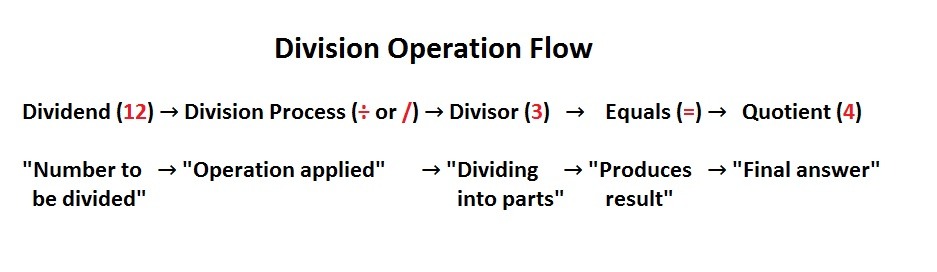
Now let’s look at how dividend works in division problems. The division operation mechanics follow this logic:
Dividend → Division Process → Quotient
A step-by-step process for mathematical problem-solving with dividends:
- Identify the dividend, which is the initial number to which the division process will be applied.
- Identify the divisor, which is the number by which the dividend is divided.
- Perform the division operation and calculate the quotient, or result.
Abstract example: ’45 ÷ 9′. In this example, the dividend is 45, the divisor is 9, and the quotient is 5.
A real-world analogy would be dividing 12 cookies among three people. In this case, the dividend is 12, the divisor is 3 and the quotient is 4, meaning each person will receive four cookies.
Identifying Dividends in Different Problem Formats
According to the National Council of Teachers of Mathematics, mastering division concepts – including an understanding of the role of the dividend – is key to enhancing mathematical and financial literacy. One of the key skills is identifying the dividend in maths problems.
Here are the dividend recognition techniques for each notation format:
- Format 1: division symbol (÷). The dividend is the number on the left. For example, in ’12 ÷ 3′, the dividend is 12. Tip: The dividend is the first number you read.
- Format 2: slash (/). The same rule applies as for the symbol ‘÷’. The dividend is the number on the left. For example, in ’20/4′, the dividend is 20.
- Format 3: fraction notation. The dividend is the numerator (the top number). For example, in ‘153’, the dividend is 15. Tip: The dividend is the number at the top of the fraction.
- Format 4: long division. The dividend is the number inside the brackets. For example, in ‘4)16’, the dividend is 16. Tip: the dividend is the number ‘inside the house’.
The dividend identification in math is the total quantity to be distributed.
Division Formats and Dividend Representation
Let’s look at the representation of the dividend in different division formats and review division terminology basics. The nuances related to the dividend in long division format and the dividend in fraction notation are shown below.
Long Division Method
The dividend in long division format is the number placed inside the bracket or under the roof. When writing a long division, the dividend is placed inside the bracket and the divisor is positioned to the left.
Consequently, the expression ‘156 ÷ 12’ is written as 12)156.
This notation format is based on the following step-by-step process:
- Take the first part of the dividend that is greater than or equal to 12. This is 15 (the first two digits: 1 and 5). Divide 15 by 12 to get 1. Write this digit above the 5 in the answer (quotient).
- Multiply 1 × 12 to get 12, then write 12 below 15 and subtract. The answer is 3, so write this under the line.
- Bring down the next digit of the dividend, which is 6. Next to the remainder of 3, this gives us the number 36. Divide 36 by 12 to get 3. Append this digit to the answer, placing it to the right of the 1, i.e. above the 6. This gives us the quotient 13.
- Multiply 3 × 12 to get 36, then write this number below the remainder and the digit that was brought down. Subtract 36 from 36 to find that there is no remainder, meaning the division is complete and the final answer is 156 ÷ 12 = 13.
As a result, on the left, we see the divisor inside the bracket and the dividend above it, with the quotient above that.
Fraction and Symbol Notation
Understanding the dividend fraction relationship is important for grasping how the top number of a fraction represents the dividend in a division expression. The dividend in fraction notation is also known as the ‘numerator’. This is the total quantity that needs to be divided by the denominator, or divisor.
The dividend position in equations depends on the notation used. Conversion between formats is permissible:
20 ÷ 4 = 20/4 = 204 = 5
The dividend of 20 is presented above in different notations. The symbols ÷ and / are equivalent. They represent the same mathematical operation.
Dividend vs Other Division Components
Let’s take a look at the division equation components and how they are related. It’s important to understand the dividend vs divisor differences. The dividend is the number being divided. The divisor is the number by which it is being divided.
In terms of the dividend vs quotient comparison, it is notable that the dividend represents the initial input value provided in the problem. The quotient, on the other hand, is the final result – the output value that needs to be found.
Below is a table of quotient vs. dividend vs. divisor differences.
| Dividend | Divisor | Quotient | |
| Definition | Number being divided | Number dividing by | Result of division |
| Position | Left/Top/Inside | Right/Bottom/Outside | After equals sign |
| Role | Total quantity | Number of parts | Size of each part |
| Can be zero | Yes | No | Yes |
| Example | In ’24 ÷ 6 = 4′, dividend = 24 | In ’24 ÷ 6 = 4′, divisor = 6 | In ’24 ÷ 6 = 4′, quotient = 4 |
Mathematical Relationship Between All Parts
The fundamental equation of the quotient, dividend and divisor relationship is as follows:
Dividend ÷ Divisor = Quotient
The above equality also satisfies other mathematical relationships between the parts:
Quotient × Divisor = Dividend
Dividend ÷ Quotient = Divisor
It follows from this that the correctness of a division can be verified by multiplying the quotient by the divisor. For example:
- Problem: ’36 ÷ 9 =?’
- Answer: quotient = 4
- Verification: ‘4 × 9 = 36’ ✓
Understanding these relationships is not just mathematical literacy requirements. It also helps us to solve complex real-world problems.
Bridge to Financial Applications – Why Mathematical Dividends Matter
To be successful in investing, it is essential to have financial literacy, mathematics literacy and quantitative analysis skills. Without these skills, it is impossible to understand key stock and portfolio metrics.
Now, let’s look at some examples of how mathematical concepts in finance are used.
Example 1 – Earnings Per Share (EPS):
- Formula: Net income ÷ shares outstanding.
- Dividend: the company’s net income; Divisor: the number of shares.
- The quotient (the sought result) is earnings per share.
Example 2 – Dividend Yield:
- Formula: Annual dividend ÷ stock price.
- Mathematical dividend: annual dividend (financial); divisor: stock price.
- The quotient: the expected annual profit that each dollar invested in the stock will generate.
Example 3 – Portfolio Allocation:
- Formula: Total Investment Amount ÷ Number of Positions.
- The mathematical dividend is the total portfolio value and the divisor is the number of assets.
- The quotient is the average position size, or the amount of investment allocated to one asset on average.
Understanding the mathematical division terms ‘quotient’, ‘dividend’ and ‘divisor’ is one of the key mathematical concepts in finance. The division concepts are applied daily for financial analysis purposes.
Financial analysts, for example, use division to calculate and analyze ratios. Portfolio managers calculate capital and asset allocation. Bankers model profit distribution. Quantitative analysts build mathematical models.
From Math Class to Financial Analysis
Developing maths skills for a finance career involves three stages:
- Learning the concept of the dividend in division and other mathematical literacy requirements.
- Improving the ability to apply the division operation mechanics to real-world problems.
- Mastering the methodology of financial calculations.
Let’s look at some examples of identifying the dividend in math problems related to finance. According to the problem, there are 1 million outstanding shares in the company. The company distributes a profit share equal to $5 million. The financial dividend (bridge concept) per share must be found.
In this case, the dividend is $5 million. The divisor is 1 million. The quotient is therefore $5.
Second example: calculating average income. According to the problem statement, the portfolio will generate $12,000 for the investor over 4 years. The average annual income must be found.
In this case, the dividend is $12,000. The divisor is 4 and the quotient is $3,000.
There are certain professional requirements. For instance, in order to obtain the Financial Risk Manager certification, one must have the necessary quantitative analysis skills. Therefore, a successful career in finance is impossible without a strong mathematical foundation.
The table below shows the difference between financial and mathematical dividends.
| Dividend (finance) | Dividend (mathematics) | |
| Definition | Corporate earnings distribution | Number being divided |
| Example | $1.2M ÷ 300K shares = $4/share | ’12 ÷ 3 = 4′ |
| Purpose | Distribute earnings to shareholders | Split quantity into equal parts |
| Skills needed | Mathematical dividend understanding + financial knowledge | Basic arithmetic |
H2: Advanced Applications and Problem-Solving Strategies
Now, let’s look at some more complex division calculation methods. These advanced division concepts are necessary for the mathematical problem-solving involved in financial sector tasks.
Scenario 1: Multi-step division:
- Problem: ‘(100 ÷ 5) ÷ 4’
- First dividend: 100
- Second dividend: the result of the first division (20)
- Final quotient: 5
Scenario 2: Decimal as dividend:
- Problem: ‘45.75 ÷ 3.5’
- Dividend: 45.75 (decimal number)
- Quotient (after rounding): 13.07 (also a decimal)
Scenario 3: Negative dividend:
- Problem: ‘-48 ÷ 6’
- Dividend: -48 (negative number)
- Rule: negative dividend ÷ positive divisor = negative quotient
- Answer: -8
The same strategy is used for the solution, regardless of the notation format or problem type. The first step is to identify the divisor and the dividend. The dividend is the quantity that is divided into parts. The divisor is the number of these parts. The second step is to perform the division operation. The third step is to verify the result by multiplying the quotient by the divisor.
Conclusion
What is a dividend in math, and why is it important to understand this concept for a career? According to the dividend definition in mathematics, a dividend is a quantity that must be divided into a specified number of parts.
In division equations, the dividend is positioned in strictly defined places:
- to the left of the symbols ‘÷’ and ‘/’;
- at the top in a simple fraction (numerator);
- inside the brackets, the dividend is ‘in the house’ in long division.
A career as a financial analyst requires an understanding of the mathematical division basics. Division concepts mastery will enhance your professional application of them.
Solving professional tasks and calculating various financial metrics is impossible without understanding the dividend position in equations and the mathematical relationship between the parts of an equation (quotient, dividend and divisor).
Study dividend mathematical properties and practice applying division concepts for financial analysis.
Frequently Asked Questions (FAQs)
Q1: What’s the difference between dividend and divisor in math problems?
The divisor and the dividend have different meanings. The dividend is the total quantity of something; it is the number that is being divided. The divisor is the number by which the dividend is divided. It is the number of parts into which the original quantity is divided.
Q2: How do I identify the dividend in different division formats?
The quotient, dividend and divisor are always positioned in specific locations. The dividend in different division formats can be found in one of three positions. In equations, it is located to the left of the symbols ‘÷’ and ‘/’. In a simple fraction, it is positioned above the horizontal line. In the long division, it is placed inside the bracket.
Q3: Can a dividend be smaller than the divisor?
Yes, the dividend can be smaller than the divisor. In this case, the quotient will always be less than one, meaning the answer will take the form of a simple or decimal fraction.
Q4: Can dividends be negative numbers?
Yes, according to the dividend mathematical properties, it can be a negative number. In this case, the quotient will also be negative if the divisor is positive. However, if the divisor is also negative, the quotient will be positive.
Q5: What’s the relationship between mathematical dividends and financial dividends?
Both uses of the term originate from the Latin ‘dividendum’, meaning ‘that which is to be divided’. In division vocabulary in math, the dividend is the number that is divided by the divisor. In finance, dividends are the portion of a company’s profits distributed among shareholders.
Q6: Why is understanding dividends important for financial careers?
A finance professional must understand the concepts of the quotient, divisor and dividend in order to solve daily tasks. Without this knowledge, it would be impossible to calculate portfolio return metrics, assess investment risks and analyze the key multipliers used in stock selection.